Automated Moderation Is Private Law for the Rented Internet
Platforms need moderation at scale. Users also need reasons, appeals, exports, and an exit when a classifier controls speech, reach, income, or account access.

Platforms cannot moderate billions of posts by hand. That does not justify an invisible checkpoint with no usable explanation, no meaningful appeal, and no exit.
Automated moderation was sold as scale machinery. Too many posts, too much spam, too much abuse, not enough humans. Fair enough. Nobody serious expects a billion-user platform to run every upload past a calm philosopher in a cardigan.
The machinery did not stay in the spam folder.
It now helps decide whether a post remains visible, a video earns money, an account can livestream, a seller can reach customers, or a creator keeps access to years of work. When one company hosts your audience, identity, archive and income, its enforcement stack behaves like private law. You get rules, penalties and appeals. You just do not get a court.
This is not an argument for an unmoderated internet. Fraud, threats, exploitation and coordinated abuse are real. It is an argument against letting opaque classifiers become the first and last layer of permission.
What the receipts establish
EFF’s July 7 report, “Automated Moderation Is Here to Stay,” revisits recommendations it made in 2020: users should receive notice, an explanation and a meaningful appeal when automated systems restrict speech. EFF is an advocacy organization, not a neutral auditor. Its article does not establish a universal error rate or prove every platform action is automated. It does establish the continuity of the dispute: emergency-scale automation became ordinary governance.
The platforms’ own documents show the governance layer.
Meta publishes Community Standards governing content and account access. YouTube documents an appeal process for eligible Community Guidelines strikes and removals. Those pages matter, but they prove process exists on paper—not that a particular decision was accurate, that a human independently reviewed it, or that the remedy arrived before a creator lost a week of income.
The European Union has gone further. Articles 17 and 20 of the Digital Services Act require covered providers to give statements of reasons for specified restrictions and provide an internal complaint system under the regulation’s terms. That is not a ban on automated moderation, and it does not guarantee restoration. It is recognition that platform enforcement needs procedure.
A punishment button without reasons is not accountability because the button has a help-center article.
The control point is bigger than deletion
A platform does not need to delete speech to control its effect.
It can reduce distribution, remove monetization, add friction, block recommendations, age-gate a post, freeze a livestream, restrict search visibility or disable an account. Some interventions will be justified. Some will be errors. The user often cannot tell which system acted, what evidence mattered, whether a person reviewed the result, or what would prevent the same decision tomorrow.
That asymmetry is the product.
Platforms know the policy, model, confidence threshold, enforcement history and internal labels. Users see a red banner and a link to rules broad enough to upholster a courthouse.
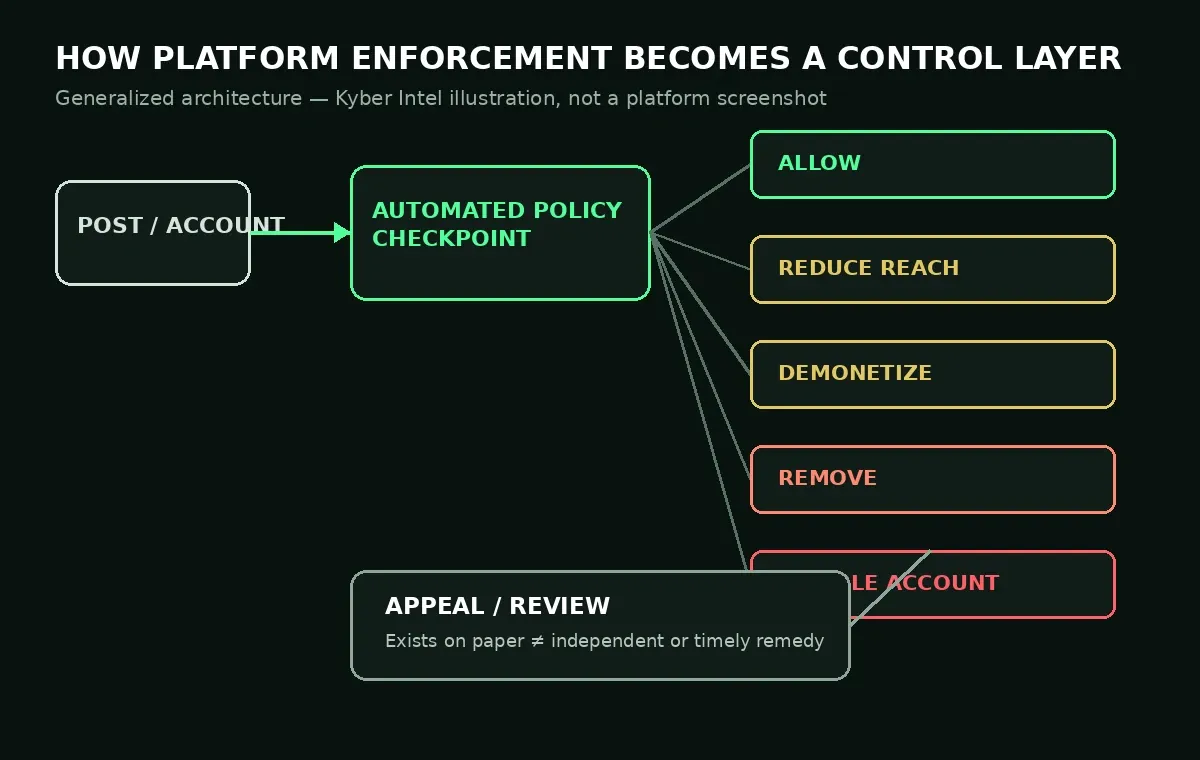
Kyber Intel illustration of the enforcement architecture. It describes possible platform outcomes; it is not a screenshot of any company’s internal system.
What platform documents do not prove
Receipt discipline matters most when the subject is a black box.
A policy page does not prove consistent enforcement. An appeal form does not prove independent review. A transparency report does not tell you why one specific account vanished. A creator’s screenshot does not prove the system was automated. And one bad decision does not prove every moderation action is malicious.
The defensible claim is narrower and more useful: centralized platforms combine rulemaking, detection, adjudication and remedy inside systems the affected user cannot inspect. Automation increases the scale and speed of that power. Weak portability increases its cost.
Platforms answer that automation is necessary to protect users and enforce rules across enormous services. They are right about the scale problem. They are not entitled to treat scale as an exemption from notice, evidence preservation, appeal and export.
The minimum sane standard
Any platform capable of cutting off speech, audience or income should provide:
- Specific notice. Name the content, action, rule and time.
- Automation disclosure. State whether an automated system made or materially influenced the decision.
- Evidence preservation. Keep the disputed content and decision record available through the appeal window.
- A usable appeal. Let the user address the actual reason, not throw text into a generic support well.
- Human escalation for serious penalties. Account deletion and income suspension deserve more than classifier confidence.
- Machine-readable export. Let users retrieve work, contacts and account history in useful formats.
- Public performance reporting. Publish meaningful enforcement and reversal data, defined carefully enough to compare over time.
The DSA creates some procedural duties for covered services and EU recipients. It is not a global bill of rights, and regulatory compliance should not be confused with user ownership.
Build exits before the appeal fails
You cannot eliminate platform risk while using platforms. You can stop making one platform load-bearing.
Own the canonical address
Use a domain you control as the permanent address for your work. Put your contact information, current channels, offers and archive there. A social account should distribute the work, not define whether it exists.
Export before trouble
Google documents data export through its account tools, and other platforms offer their own downloads. Use them on a schedule. Export support varies, and no archive recreates reach, monetization or an audience graph. That is why the backup must happen before a dispute.
Keep local copies of posts, captions, video masters, thumbnails, customer-safe records and source files. Test whether the export opens. A backup you never restored is a comforting rumor.
Build a direct channel
Email and RSS are not glamorous. Good. Glamour is how rented distribution distracts people from ownership. Give readers a way to follow you that does not depend on one recommendation system.
Prefer portable protocols where they fit
ActivityPub is a W3C standard for interoperable social networking. Mastodon documents account migration that can redirect followers between compatible accounts. This is an architectural improvement, not magic: old posts and media do not automatically move, servers still moderate, and implementations differ. Federation reduces some switching costs; it does not abolish power.
Keep a dependency sheet
List every platform that can cut off your audience, identity, files or income. Record the recovery email, export path, backup date, alternative channel and consequence of a 30-day lockout. If the answer is “the business disappears,” you found the next migration project.
Bottom line
Moderation is necessary. Unaccountable moderation is not.
The real danger is not one stupid classifier. It is an economy where the same company writes the rules, runs the detection system, imposes the penalty, controls the appeal and owns the only copy of the audience relationship.
Use the platforms. Do not confuse access with ownership.
Own your domain. Keep local archives. Build email and RSS. Export on a schedule. Favor open formats and portable protocols. Make the machine one distribution layer—not the landlord of your identity.
Sources
- https://www.eff.org/deeplinks/2026/07/part-1-automated-moderation-here-stay
- https://eur-lex.europa.eu/eli/reg/2022/2065/oj
- https://transparency.meta.com/policies/community-standards/
- https://support.google.com/youtube/answer/2802032
- https://support.google.com/accounts/answer/3024190
- https://www.w3.org/TR/activitypub/
- https://docs.joinmastodon.org/user/moving/